


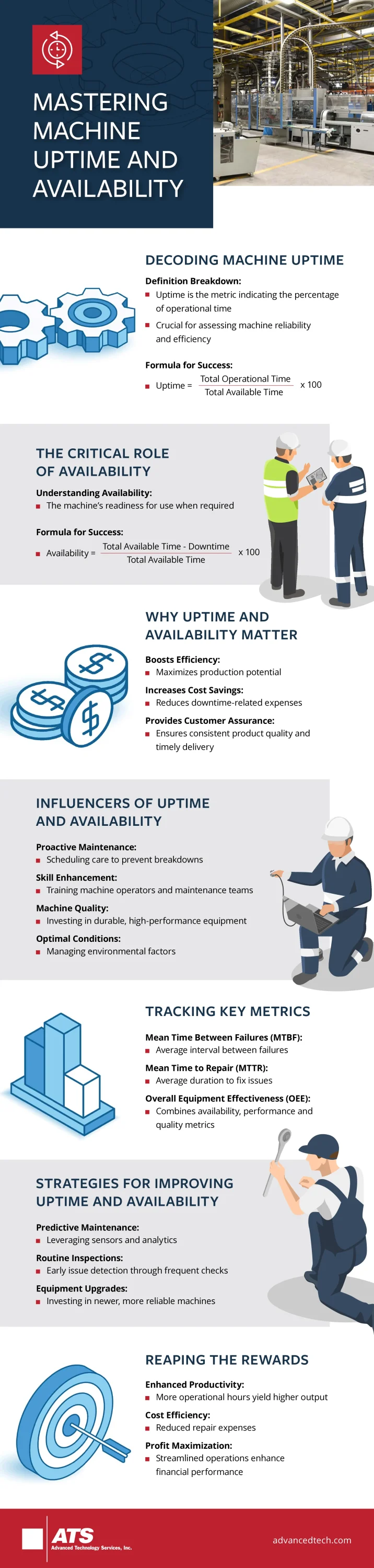
Machine uptime and availability are integral to the success of any manufacturing operation. Achieving high uptime ensures that equipment is continually productive, while maintaining high availability ensures that machines are always ready to meet production demands. Manufacturers who focus on improving these two critical metrics can achieve higher operational efficiency, lower costs, and greater customer satisfaction.
Machine uptime refers to the duration that machinery is operational and in active use. Uptime is a key performance indicator (KPI) that manufacturers track to gauge the effectiveness of their equipment. Maximizing uptime involves proactive maintenance strategies such as routine inspections, part replacements, and preventive repairs that keep machinery running smoothly without interruptions.
Availability, on the other hand, refers to the machine’s readiness to be used when needed. While uptime measures functionality, availability ensures that equipment is accessible and operational without delays. Maintaining high availability involves timely maintenance schedules, keeping spare parts readily available, and ensuring that machines are operational between shifts or production runs.
Preventive maintenance is a cornerstone of improving uptime and availability. Routine preventive maintenance services such as lubrication, calibration, and system checks help prevent sudden equipment failures. Predictive maintenance, which leverages real-time data from IoT sensors and machine learning algorithms, can predict potential failures and allow manufacturers to intervene before problems occur, reducing downtime and maintaining high uptime.
The skills and training of operators and maintenance personnel are essential to minimizing downtime. Well-trained staff can identify and troubleshoot issues quickly, ensuring that machines are back online with minimal delay. Ongoing training ensures that operators remain proficient in the latest technologies and best practices for machine maintenance.
Investing in high-quality machinery with built-in diagnostic capabilities also helps improve uptime and availability. These machines are equipped with real-time performance monitoring systems that provide insights into machine health and notify maintenance teams of potential issues. Additionally, environmental factors such as air quality and temperature should be controlled to prevent external factors from affecting machine performance.
Key performance metrics such as Mean Time Between Failures (MTBF) and Mean Time to Repair (MTTR) are used to track and evaluate machine uptime and availability. By focusing on increasing MTBF and reducing MTTR, manufacturers can achieve higher uptime and availability, leading to enhanced operational efficiency.
Through a combination of preventive and predictive maintenance, employee training, and smart investments in reliable equipment, manufacturers can significantly improve machine uptime and availability, resulting in higher productivity, lower costs, and better service delivery.

Comments are closed.